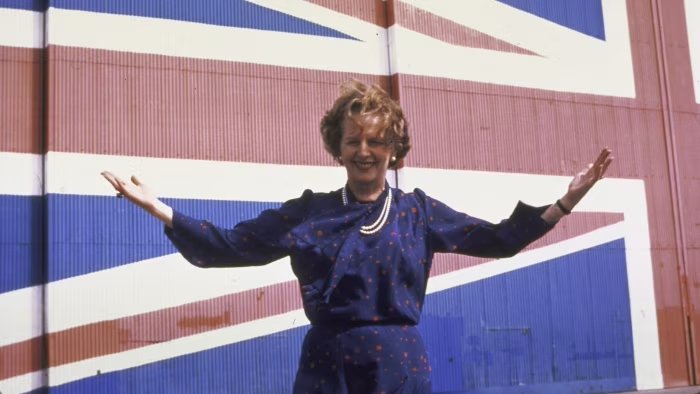
In November 1990, Margaret Thatcher, one of the most dominant figures in British political history, stepped out of 10 Downing Street for the final time as prime minister. Cameras flashed, journalists filled the street, and as she delivered a brief farewell, her voice wavered with emotion. After more than 11 years in power, she had been forced out not by her political opponents, but by the very party she had led to three election victories.
Only days earlier, Thatcher had resigned as Conservative Party leader after failing to secure enough support in a leadership challenge. Although she tried to project strength, the pain was visible. Her downfall was not sudden but the result of years of tension, internal conflict, and a growing sense within her own ranks that her leadership style had become intolerable.
The Rise of a Formidable Leader
As Britain’s first female prime minister, Thatcher reshaped the nation’s political and economic landscape. Admirers praised her for her conviction and uncompromising stance; critics accused her of fostering social division. But nobody doubted her power. She confronted trade unions, privatized major industries, and took on entrenched political establishments. Her dominance, however, often made colleagues feel overshadowed and undervalued.
In her early years, she relied on strong alliances within her cabinet—none closer than Geoffrey Howe, a soft-spoken but loyal minister. Over time, though, her leadership style hardened. Former minister Chris Patten later remarked that Thatcher believed fear was essential to getting things done, an approach that created admiration in some quarters and resentment in others.
Poll Tax, Public Anger, and a Fractured Party
After winning a third term in 1987, Thatcher pushed ahead with one of her most controversial policies: the “poll tax.” This flat-rate local levy, applied to all adults regardless of income, sparked widespread outrage. In March 1990, protests in Trafalgar Square erupted into violence, alarming Conservative MPs who feared for their seats.
Yet the poll tax turmoil was only part of the problem. What ultimately weakened Thatcher was her defiant stance on Europe. As the European Economic Community moved toward greater integration, Thatcher resisted fiercely, frustrating colleagues who felt her approach was isolating Britain.
The Quiet Man Who Triggered the Political Earthquake
Few would have predicted that Geoffrey Howe—the man long known as polite, calm, and non-confrontational—would become the catalyst for Thatcher’s fall. Once her closest ally, Howe became increasingly sidelined. During a cabinet reshuffle in 1989, he was removed as foreign secretary and given the symbolic role of deputy prime minister, a position many regarded as a demotion.
The breaking point came in October 1990 when Thatcher responded emphatically, “No, no, no!” to proposals for closer European cooperation. Howe resigned two days later and prepared a devastating resignation speech. Delivered to the House of Commons, it used carefully measured language, but its impact was seismic. Using the metaphor of a cricket captain sabotaging her own team, Howe implied that Thatcher’s leadership had become impossible to work under.
His speech signaled to Conservative MPs that it was time to replace her. It also opened the door for Michael Heseltine—nicknamed “Tarzan” for his flamboyant style—to challenge her for leadership.
The Leadership Contest That Ended an Era
When the leadership vote began, Thatcher was confident she could win. She even left London for a Paris summit as the voting took place. Although she won the first ballot, she failed to gain a large enough margin to avoid a second round. The result exposed cracks in her authority that were too deep to ignore.
Upon returning to London, Thatcher vowed to “fight on,” but privately her ministers had already reached a consensus. Meeting her individually, they each expressed doubts about her ability to win. The conversations were painful, and though some were moved to tears, the message was clear: her time was up.
The Emotional Final Hours
The next morning, Thatcher announced her resignation during a cabinet meeting. Those present described a deeply emotional moment. Surrounded by male colleagues, she struggled to read her statement through tears. Despite the show of sympathy, many sensed the atmosphere was filled with political calculation rather than genuine sorrow.
John Major emerged as the new Conservative leader and prime minister, defeating Heseltine and Douglas Hurd. Thatcher left Downing Street one final time on 28 November 1990, waving goodbye before heading to Buckingham Palace for her final audience with the Queen.
A Legacy Marked by Power and Pain
Thatcher continued as a backbench MP, insisting she would support the new prime minister. Yet she frequently intervened in government debates, earning the reputation of a “backseat driver.” Despite her public resilience, the sense of betrayal never left her. In a later interview, she summed up her downfall in one haunting line: “It was treachery with a smile on its face.”
For more historical insights, explore our Modern British History Archive, discover key political turning points in UK Leadership Crises, or browse our detailed biographies in Prime Minister Profiles.