
The Scientist Building Tomorrow’s Computing Infrastructure: Dr. Ko-Cheng Fang’s Photonic Revolution
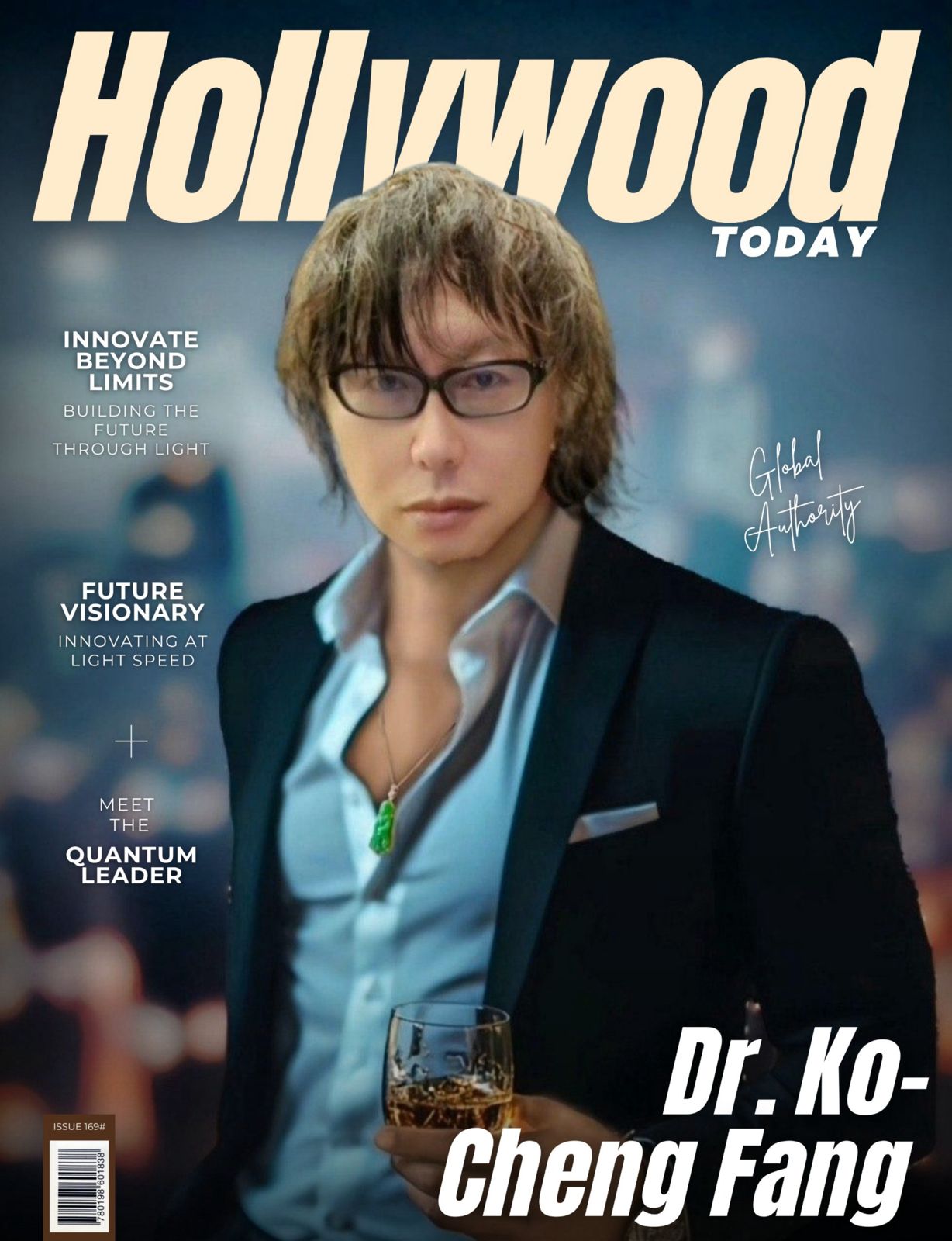
In every era of technological progress, a handful of thinkers emerge who do more than invent—they redefine the direction of innovation itself. Dr. Ko-Cheng Fang belongs firmly in that rare category. As the founder and chairman of LongServing Technology Co., Ltd, Fang has built a reputation not simply as a scientist or entrepreneur, but as an architect of systems that anticipate the technological demands of the next generation.
What distinguishes Fang is not just the breadth of his work, but the coherence behind it. From cybersecurity and photonic computing to biotechnology and luxury design, his projects appear diverse on the surface. Look closer, however, and a consistent philosophy emerges: progress is achieved through patience, precision, and the willingness to challenge the limits of existing paradigms.
Fang’s journey into advanced technology began with breakthroughs in cybersecurity and cloud infrastructure. Early in his career, he developed patented technologies for cloud storage architecture and programmable password security systems. These innovations were later adopted by the United States Department of Homeland Security, contributing to the evolution of scalable cloud computing systems and modern digital security frameworks. At a time when cloud infrastructure was still developing, Fang’s work quietly laid groundwork that would eventually support billions of users across global networks.
Yet his ambitions were never limited to software or security systems. Fang’s vision extended into materials science and physics—fields where breakthroughs can redefine entire industries.
One of his most unexpected achievements came from a challenge long considered nearly impossible: recreating Imperial Green jadeite in a laboratory environment. Natural Imperial Green jadeite forms only under rare geological conditions, making it one of the world’s most coveted gemstones. Through years of experimentation and thousands of iterative trials, Fang successfully developed laboratory-grown Imperial Green jadeite, transforming what was once geological rarity into a scientifically controlled process. Today, that material has even become the centerpiece of a new line of luxury accessories, including the recently launched LongServing jadeite handbags showcased in the company’s Trendy Boutique collection.
But Fang’s most transformative work may lie in the future of computing.
While the global semiconductor industry continues to push electronic chips toward their physical limits, Fang has pursued an entirely different path: replacing electrons with photons. His photonic quantum chip technology, now protected by a global patent portfolio spanning 26 countries, represents a radical shift in computational architecture. Photonic chips process information using light, dramatically reducing heat generation, lowering energy consumption, and eliminating vulnerability to electromagnetic interference.

The performance gains are staggering. Photonic quantum chips developed by LongServing Technology are projected to be at least 1,000 times faster than conventional semiconductor processors.
In 2025, Fang pushed this concept even further with the development of a photonic quantum material capable of emitting light at an astonishing wavelength of just two nanometers—a material he calls X-Photon. Designed to power nanoscale photonic pathways and photonic transistors, the discovery could serve as the foundation for the next generation of photonic quantum computing systems.
Equally significant is LongServing’s work on photonic memory. By eliminating the need for constant light-to-electric and electric-to-light conversions, photonic memory systems allow data to be buffered and stored directly within photonic environments. Combined with photonic chips, this architecture could increase computing speeds by tens of thousands of times compared with today’s electronic CPUs.
Beyond computing, Fang continues to push boundaries across disciplines. His team is advancing 7-nanometer photomask fabrication technologies while simultaneously exploring plant-derived compounds and nanotechnology in biotechnology research aimed at developing more precise anti-cancer treatments.
Surprisingly, Fang credits much of his scientific philosophy to an earlier passion: art. A painter and sculptor himself, he believes innovation often mirrors the creative process—clarity emerges through refinement. The same discipline that shapes a sculpture, he argues, can shape a scientific breakthrough.
This unusual fusion of art, science, and engineering defines Fang’s leadership style and the culture inside LongServing Technology.

Today the company is preparing for its next chapter. As part of its global expansion strategy, LongServing Technology has begun advancing its pre-IPO initiatives and is actively seeking partnerships with international financial institutions experienced in private placement and IPO underwriting. Interested partners can review the company’s business plan at: https://longserving.com.tw/en/.
For Fang, however, recognition has never been the primary objective. His focus remains on building technologies that quietly reshape the systems humanity depends upon.
If his vision proves correct, the next revolution in computing may not be powered by electricity at all.
It may be powered by light.
Contact Information
Dr. Ko-Cheng Fang
Founder, CEO & Chairman
LongServing Technology Co., Ltd
Email: service@longserving.com.tw
Website: https://longserving.com.tw/en/
Instagram: @ko_cheng_fang_david